Parking Lot Lighting Repair in Phoenix
Parking lot lighting repair in Phoenix keeps your property safe, visible, and code-compliant the moment poles start going dark, fixtures flicker, or a whole section trips out during business hours.
Tell us what's happening with your lot and get connected with a background-checked Phoenix electrician who diagnoses the real cause and quotes an upfront price before any work starts.
No app to download. Works right in your browser.
ShowUp Guarantee, no-show means no pay.
Why Parking Lot Lighting Repair Matters for Phoenix Properties
A dark or unevenly lit parking lot is more than a nuisance, it's a real liability. Weak or missing light near entrances and walkways is one of the first things insurers and attorneys point to after a slip-and-fall or a security incident on commercial property, and most municipal codes set a minimum light level for exactly that reason.
Beyond safety, a lot with dead poles or flickering fixtures reads as neglected the moment a customer, tenant, or employee pulls in after dark, it's often the very first impression your property makes.
ShowUp Promise matches you with a vetted, licensed, insured, background-checked electrician who diagnoses the actual fault instead of guessing, and backs the work with the ShowUp Guarantee: if they don't show up when promised, you don't pay.
Common Parking Lot Lighting Failures We Fix
Most parking lot lighting problems trace back to a handful of recurring failure points. Your electrician checks all of them rather than swapping the first bulb they see:
- Failed photocells or sensors, the fixture never turns on, or cycles on and off all night
- Ballast or LED driver failure, the most common cause of a single dead fixture in an otherwise-working row
- Underground wiring faults, a damaged conduit run or bad splice that can take out an entire section at once
- Cracked lenses or corroded housings, moisture intrusion that shorts out a fixture from the inside
- Loose or damaged pole wiring, vibration and heat cycling work connections loose over years
- Aging metal halide or high-pressure sodium fixtures, increasingly unreliable and expensive to keep in parts
What the Repair Work Actually Involves
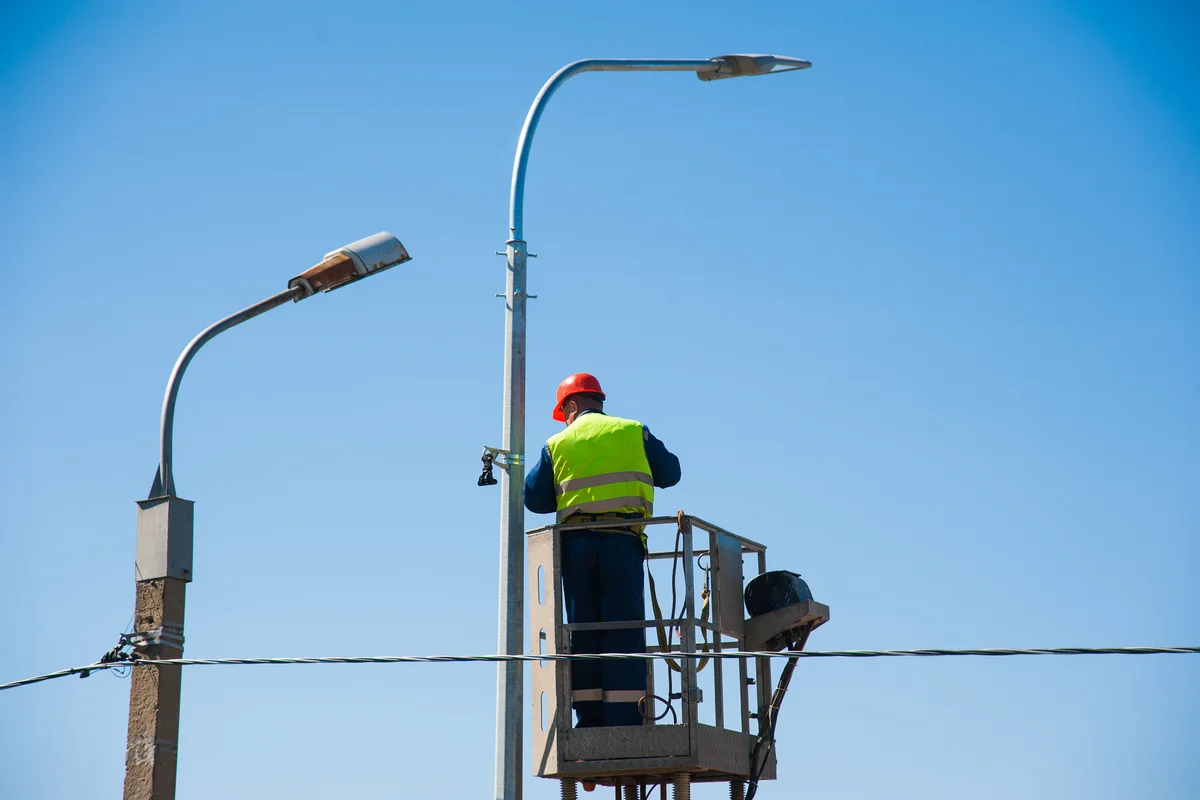
Most pole-mounted fixtures sit 20 to 40 feet up, so the job starts with a bucket truck or aerial lift positioned safely away from parked cars and drive lanes, not a ladder propped against the pole.
Once at the fixture, your electrician tests the photocell, ballast or driver, and wiring in sequence to isolate the actual fault rather than replacing parts on a guess. If the problem traces back to the underground feed, they'll meter the circuit at the panel or handhole before opening any pavement.
Everything is checked against current electrical code for wire gauge, breaker sizing, and grounding , parking lot circuits carry real amperage across long runs, and undersized or degraded wiring is a fire risk your electrician won't leave in place.

Why Phoenix Parking Lots Need This More Than Most
Year-round UV exposure breaks down photocell sensors and wiring insulation faster here than in milder climates, and properties along the Camelback Corridor, Deer Valley, and the 44th Street/Sky Harbor employment corridor run their lots hard, retail and office traffic well past sunset most of the year.
Monsoon season adds its own damage: wind-driven dust works into fixture housings and connections near the I-17 and Loop 101 corridors, and a single haboob can knock out a photocell or short a marginal connection that had been limping along for months.
Because many Phoenix retail and office tenants keep hours well into the evening to avoid the daytime heat, a dark lot near Desert Ridge, Arcadia, or the Metrocenter area isn't a minor issue , it's peak traffic happening in the dark.
Permits, Code, and Working Safely at Height
Straight repairs, a photocell, ballast, driver, or fixture swap on existing wiring, generally don't need a permit. New conduit runs, added poles, or a circuit upgrade typically require a City of Phoenix commercial electrical permit.
Your ShowUp Promise electrician tells you which category your job falls into and pulls any required permit as part of the work. Properties in Scottsdale, Tempe, Mesa, Chandler, or Gilbert fall under that city's own building department instead.
Working from a bucket truck or lift at 20-plus feet over pavement and parked cars carries real fall and traffic-control risk, which is why illumination and outdoor electrical work is covered under OSHA's illumination and construction safety standards. Your electrician sets up traffic cones and lift stabilizers before anyone goes up, not as an afterthought.
What Parking Lot Lighting Repair Costs in Phoenix
A photocell or sensor swap typically runs $150 to $300 per fixture. A failed ballast or LED driver usually falls between $250 and $500 per pole, including the lift needed to reach it.
A deeper wiring fault, a damaged underground conduit run or a bad splice feeding multiple poles , commonly runs $500 to $1,500 depending on how much conduit repair is involved. Every ShowUp Promise electrician gives you an itemized, upfront price after inspecting the actual fixtures, never a phone-quote guess.
Serving Phoenix Properties and the Whole Valley
ShowUp Promise matches property owners and managers with electricians across Phoenix and the wider Valley, including the Camelback Corridor, Deer Valley, Desert Ridge, Arcadia, Scottsdale, Tempe, Mesa, Chandler, and Gilbert. Wherever your lot is going dark, there's likely a vetted pro nearby ready to fix it.
Need a commercial electrical contractor for a bigger project, or other electrical work alongside your parking lot lighting repair? Our network also handles an emergency electrician, a licensed electrical contractor, general electrical repair, electrical panel replacement, general electric service, an electrical inspection, surge protector installation, GFCI outlet installation, recessed lighting installation, pool light repair, Level 2 EV charger installation, smoke detector repair, ceiling fan repair, attic fan installation, a North Phoenix electrician, and whole house fan installation. You can also browse all of our trusted contractors in Phoenix in one place.
The ShowUp Guarantee
Every electrician in the ShowUp Promise network is vetted, licensed, insured, and background-checked before they ever reach your property. You approve the price before work starts, and if a pro doesn't show, you don't pay, the system reassigns your job to the next available verified pro instead.
Parking Lot Lighting Repair Phoenix FAQ
How Much Does Parking Lot Lighting Repair Cost in Phoenix?
Why Do Parking Lot Lights Suddenly Go Out or Start Flickering?
Do I Need a Permit for Parking Lot Lighting Repair in Phoenix?
How Long Does Parking Lot Lighting Repair Take?
Can You Convert My Parking Lot Lights to LED While Repairing Them?
Do You Offer Emergency Parking Lot Lighting Repair in Phoenix?
Get Your Phoenix Parking Lot Lights Fixed Right
Tell us what's happening with your lot, then match with a vetted, licensed, insured Phoenix electrician who diagnoses the real cause, quotes it upfront, and shows up when they say they will.